- Blog Listing
- Where to Dispose of Ink Cartridges?
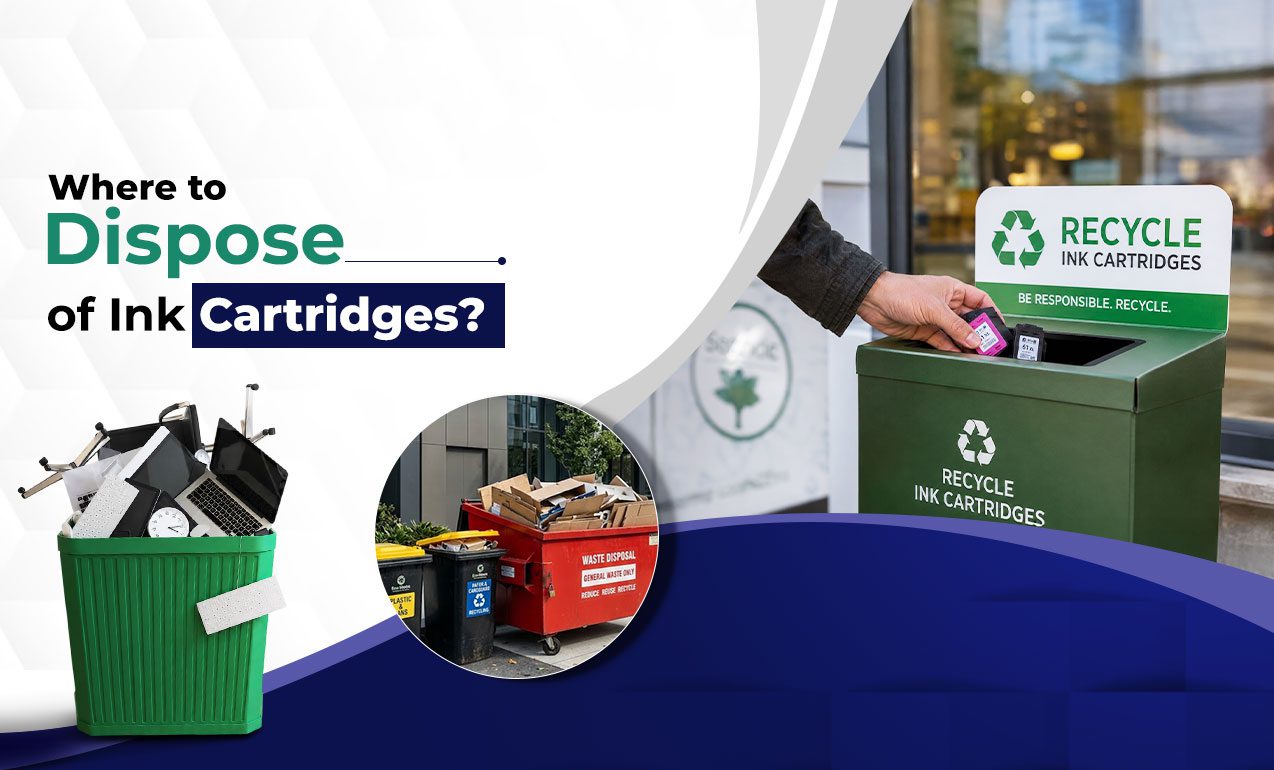
Where to Dispose of Ink Cartridges?
 Allysin-Pinto
 May 22, 2026


Office printers are a fundamental part of daily operations, but disposing of empty ink cartridges presents a hidden compliance challenge for facilities managers and office managers alike. It is a common misconception that these items can simply be thrown into general office bins because they are small, lightweight, and often perceived as ordinary plastic waste. Printer cartridges contain residual ink or toner, mixed materials, and electronic components that require controlled disposal and specialist recycling routes.
In reality, leftover inks and toners from printing machines must be handled responsibly. They contain chemicals that can negatively impact both the environment and human health if not handled correctly after disposal.
So, the question of where to dispose of ink cartridges comes up more often than most offices and facilities managers would like to admit.
This guide explores the essential aspects of commercial cartridge disposal. It covers why ink and toner cartridges cannot go in general waste, what UK law requires from businesses, how to dispose of them responsibly, and what happens once they are collected by an authorised waste carrier.
If you manage commercial premises, oversee the IT department of a facility, or are handling an office clearance, read this post to understand the safest, most efficient disposal routes of ink cartridges.
By following the guidelines outlined here, you can ensure your business minimises its landfill impact and secures the necessary compliance documentation, such as Waste Transfer Note and WEEE disposal certification, for a complete, legally compliant audit trail.
Why can’t you just bin ink cartridges?
While ink cartridges may appear small and harmless, they present significant environmental and waste classification risks. For all types of businesses, regardless of the volume of waste they generate, placing them in the general waste bin is neither compliant nor a sustainable decision.
Here is why commercial ink cartridges must be disposed of responsibly:
- Hazardous residual chemicals: Even a cartridge that feels empty retains a small amount of liquid. This residual ink contains chemical compounds, including pigments, solvents, and preservatives. When cartridges are sent to landfill, the weight and compression of surrounding waste can crack or rupture the plastic casing over time, allowing leftover ink and toner residue to leak into surrounding soil and groundwater systems. As a result, inks and toners from printing machines must be treated carefully to ensure they do not impact human health or the environment.
- Complex material composition: A standard inkjet cartridge is not just a single piece of plastic. It contains durable plastic housing, metal components, and an electronic microchip that requires proper processing.
- Centuries to decompose: The heavy-duty plastic casing used in most cartridges takes between 450 and 1,000 years to break down in a landfill. This raises concerns not just about the current but also the long-term impact of the cartridges disposed of in the landfill.
- Significant commercial volume: Across the UK, an estimated 45 million empty cartridges are sent to landfills each year. At a corporate scale, improper disposal of such a large number of cartridges will significantly contribute to an unsustainable waste stream.
Are Businesses Legally Obligated to Dispose of Ink Cartridges Responsibly?
In the UK, printer cartridges fall within the scope of the Waste Electrical and Electronic Equipment (WEEE) Regulations, which makes businesses legally obligated.
Printer cartridges have been formally classified as Category 3 WEEE (IT and Telecommunications Equipment) under Environment Agency scope guidance. This classification means empty ink cartridge disposal by UK businesses cannot go through general commercial waste channels.
The legal obligations stem from two areas of legislation.
WEEE Regulations
Under the WEEE Regulations 2013 and subsequent amendments, businesses that produce waste printer cartridges must ensure those cartridges are collected, treated, and processed through a WEEE recycling route. They must be transferred through a registered waste carrier and processed at an approved WEEE treatment facility with the appropriate environmental permits and documentation in place. They must be transferred through a registered waste carrier.
The regulations were updated significantly in January 2025, with full WEEE compliance responsibility shifting to UK importers for electronic and electrical products placed on the British market by non-UK producers.
Further amendments introduced additional reporting and collection requirements. The direction of these changes is consistent with increased accountability, clearer enforcement, and stricter standards for what counts as compliant disposal. This makes every business producing ink cartridges as waste obliged to treat them responsibly.
Environmental Protection Act 1990 and Duty of Care
The Duty of Care provisions under the Environmental Protection Act 1990 apply to all controlled waste, including printer cartridges. Your organisation has a legal obligation to manage waste responsibly, transfer it only to a responsible carrier, and retain a Waste Transfer Note (WTN) confirming how and where the waste was disposed of.
Failing to comply with Duty of Care requirements is a violation of the UK’s regulations and can result in fines and enforcement actions from the environmental agency. More practically, if waste from your premises is found to have been improperly disposed of and no compliant transfer record exists, your organisation can be held directly liable and hence may face potential legal consequences.
Where to Dispose of Ink Cartridges?
Businesses have several options for disposing of empty ink cartridges in a compliant manner in the UK. The right option depends on the volume generated, whether disposal is part of a one-off clearance or an ongoing operational need, and the level of documentation your organisation requires.
Manufacturer Take-Back Schemes
Most major printer manufacturers run their own return and recycling programmes. HP’s Planet Partners scheme, Canon’s Cartridge Recycling Programme, and similar offerings from other landmark companies provide prepaid return labels or collection bags for empty cartridges. For a single-brand office environment with moderate volumes, these are a straightforward disposal route.
Most manufacturer schemes only accept their own branded cartridges. A mixed-brand environment, or one using compatible, refilled, or third-party cartridges, will often find these schemes cover only a portion of the waste generated. In these cases, businesses typically need to use an authorised WEEE waste carrier that can collect and process multiple cartridge brands through a compliant recycling route. This is often the more practical option for offices managing larger volumes or mixed printer fleets.
A mixed-brand environment, or one using compatible, refilled, or third-party, or remanufactured cartridges, will often find these schemes cover only a portion of the waste generated. They may not be designed for bulk ink cartridge disposal in the UK. In these cases, businesses typically need to use an authorised WEEE waste carrier that can collect and process multiple cartridge brands through a compliant recycling route. This is often the more practical option for offices managing larger volumes or mixed printer fleets.
Retailer and Office Supplier Collection Points
Some office supply retailers provide in-store or postal collection for empty cartridges. These are generally aimed at consumer volumes and small-office use.
For commercial premises generating regular volumes of empty cartridges across multiple printer types, collection point schemes are rarely adequate as a primary disposal route.
Authorised Waste Carriers
While commercial operations generate higher volumes of empty cartridges, many businesses need to clear a stockpile of cartridges alongside a wider office clearance. A professional waste carrier with WEEE handling authorisation is the most practical and legally sound route for their office printer cartridge disposal.
An approved carrier will collect your cartridges, along with other WEEE waste, from your premises and provide a Waste Transfer Note confirming the legal transfer. They will also issue a WEEE Disposal Certificate confirming the compliant recycling of your waste. This approach satisfies both the WEEE Regulations and Duty of Care obligations in a single process, with proper documentation.
It is also the most efficient route when ink cartridges are part of a broader clearance. Printers, cartridges, monitors, IT equipment, and peripherals can all be collected in a single visit rather than coordinated through multiple separate programmes.
What to Confirm Before Any Disposal Takes Place?
Regardless of which route you choose, confirm the following before proceeding with any empty cartridge disposal in the UK:
- The carrier holds a current waste carrier licence issued by the Environment Agency.
- The receiving facility holds a valid Environment Agency permit for WEEE treatment.
- A Waste Transfer Note will be issued confirming the legal transfer of waste.
- A WEEE Disposal Certificate will be provided confirming the cartridges entered an authorised recycling stream.
What Happens to Ink Cartridges After Recycling?
This is the part most businesses never see, but it matters to ensure minimal environmental impact of ink cartridge disposal. Understanding the process explains both why proper disposal is worth the effort and why the materials inside a cartridge have recoverable value beyond their single-use life.
Once collected through a compliant route, cartridges go through a structured recovery process at a licensed WEEE treatment facility. The exact process varies by cartridge type and condition, but follows four clear stages.
1. Sorting and Inspection
Cartridges are sorted by type, brand, and condition. Those assessed as suitable for remanufacturing are separated immediately. Remanufacturing, where a cartridge is cleaned, refilled, and tested back to original performance standards, is the highest-value outcome.
It is also the option with the smallest environmental footprint, since it extends the life of existing materials without requiring new ones.
2. Remanufacturing (where viable)
Cartridges that pass the quality threshold are vacuumed and cleaned thoroughly to remove all residual ink or toner. Critical components are replaced, the cartridge is refilled, and it is print tested. It means the cartridge is tested using compatible printers to check print quality, ink flow, alignment, and chip recognition before repackaging.
Remanufactured cartridges that meet ISO standards re-enter the market as functional products. The original casing, components, and chip are used again rather than being broken down.
3. Material Recovery (for non-remanufacturable cartridges)
Cartridges that cannot be remanufactured are broken down into their component materials. Residual ink is removed first to prevent contamination of the recycling stream.
The cartridge is then separated into plastics, metal components, and electronic chips, each directed to the appropriate recycling facility. Recovered plastics are used to make new cartridges and other manufactured goods. Metals re-enter the metals supply chain.
4. Energy Recovery (last resort, zero landfill)
Cartridges that are too damaged for material recovery are shredded and processed through Energy from Waste (EfW) incineration at waste treatment facilities. The heat generated is captured for energy production, and nothing goes to landfill.
Materials Recovered from Recycled Cartridges
- Engineering-grade plastics are used to produce new cartridge housings and other consumer products.
- Steel and aluminium are recovered from internal components and returned to the metals manufacturing supply chain.
- Electronic components, including the chip and circuitry, are separated and sent through specialist electronic waste recovery processes. During the processes, valuable materials are extracted and reused within electronics manufacturing supply chains.
- Recovered ink pigments, which in specialist facilities are separated for reuse rather than treated as contaminated waste.
Sort Your Cartridge Disposal as Part of a Complete Office Clearance
For facilities managers and operations leads handling an office clearance, a refurbishment, or a relocation, ink cartridges are one item in a longer list of waste streams requiring compliant management. Printers, monitors, servers, computers, cables, batteries, and fluorescent tubes all carry the same WEEE obligations.
Handling each category through a separate disposal route creates administrative fragmentation: multiple carriers, multiple documentation trails, multiple certificates to track and store. A professional office clearance service with WEEE authorisation consolidates all of this into a single collection, a uniform process, and a single compliance pack.
At Office Clearance, we handle all WEEE waste generated during commercial clearances across London and the UK, including empty ink and toner cartridges, printers, and associated IT peripherals.
If you are asking where to dispose of ink cartridges for your business, the answer is a professional, authorised WEEE carrier that can provide you with the documentation to prove it.
Ready to clear your empty ink and toner cartridges through a compliant collection route?
Office Clearance provides licensed WEEE collection and disposal across the UK, with full compliance documentation issued after every clearance. Contact us to discuss and hire our electronic and IT clearance services to ensure the responsible disposal of office ink cartridges.

