- Blog Listing
- Carbon Neutral vs Net Zero: What’s the Difference?
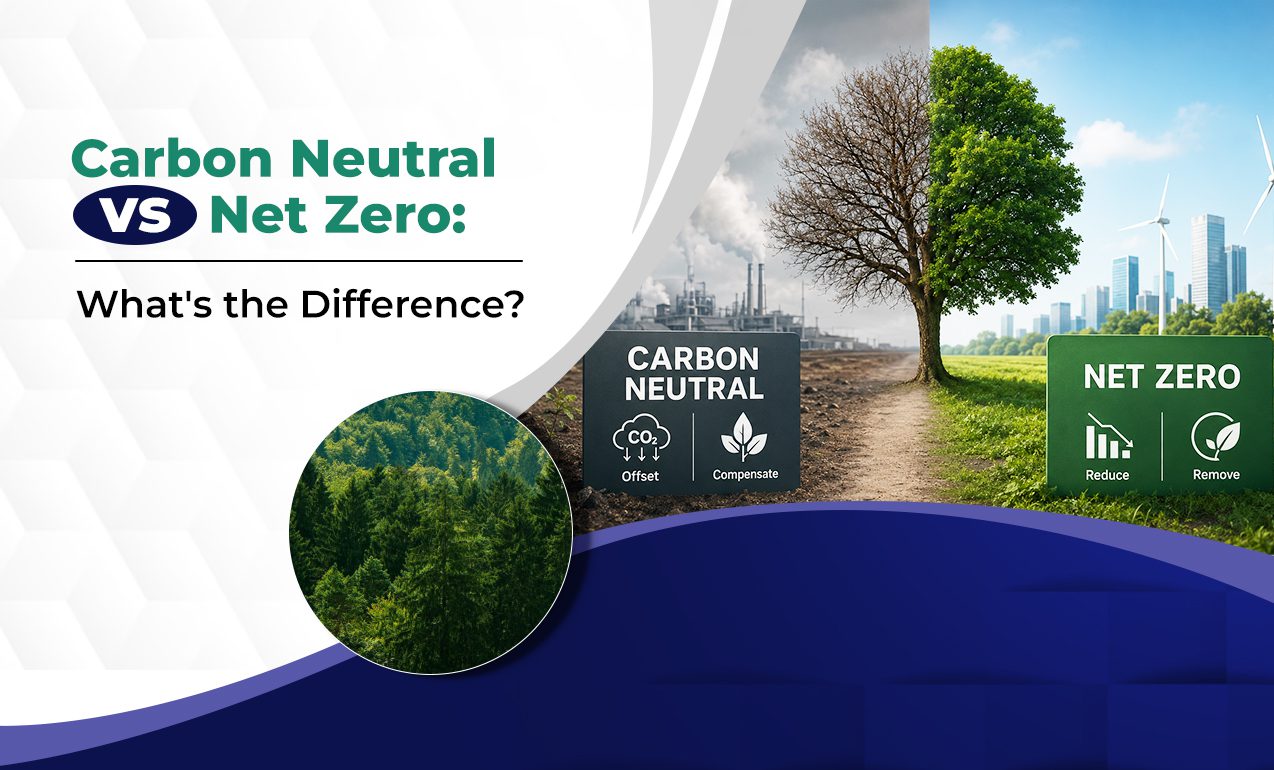
Carbon Neutral vs Net Zero: What’s the Difference?
 Allysin-Pinto
 July 10, 2026


Climate commitments have become a standard part of business strategy across the UK. Customers, investors, employees, and regulators increasingly expect organisations to understand and reduce their environmental impact.
As a result, terms such as carbon neutral and net zero appear in sustainability reports, procurement requirements, and supplier assessments more often than ever before.
Although they are sometimes used interchangeably, they describe different approaches to managing greenhouse gas emissions.
Understanding the carbon-neutral vs net-zero debate gives businesses a clearer basis for setting realistic environmental goals. It also makes it easier to evaluate suppliers and choose commercial waste management services that genuinely support their wider sustainability objectives.
For facilities managers, office managers, operations teams, and commercial property managers, this knowledge has practical value.
Every office relocation, refurbishment, or clearance creates waste, generates transport emissions, and influences the organisation’s overall environmental performance. Working with contractors that prioritise reuse, recycling, and responsible disposal can support wider sustainability objectives while reducing emissions.
This comprehensive article clarifies the difference between net zero and carbon neutral, outlines how businesses can transition from carbon neutral to net zero, and explains how sustainable waste management plays a vital role in reducing your business’s carbon footprint.
What is Carbon Neutral?
To be carbon neutral means that the total volume of greenhouse gas emissions your business releases into the atmosphere is balanced by an equivalent volume of carbon emissions offset or removed externally.
Achieving carbon neutrality follows a three-step operational sequence:
• Measurement: Calculating the current carbon footprint of your business operations (usually focusing on Scope 1 and Scope 2 emissions, and occasionally selected Scope 3 emissions). This provides a clear understanding of where emissions are generated and where reductions are possible.
• Reduction: Implementing internal efficiency measures to lower direct emissions where feasible. Examples include improving energy efficiency, reducing waste, or switching to lower carbon technologies.
• Offsetting: Purchasing certified carbon credits to neutralise any remaining unavoidable emissions. These projects compensate for residual emissions by supporting activities that reduce or remove carbon elsewhere.
Practical Corporate Examples of Carbon Neutrality
• Carbon-Neutral Office Operations: An office-based business reviews the emissions generated by its electricity and heating use over the course of a year. It improves energy efficiency by installing LED lighting and introducing measures to reduce paper consumption. Once these changes have lowered its emissions, the business offsets the remaining amount by investing in certified reforestation projects, allowing its office operations to achieve carbon neutrality.
• Carbon-Neutral Transport Logistics: A logistics firm calculates the fuel emissions of its diesel fleet. It then purchases carbon offsets to fund wind and solar farm developments, matching the carbon output of its vehicles tonne-for-tonne.
Carbon neutrality gives businesses a practical way to begin taking responsibility for their emissions. While remaining emissions can be balanced through verified offsets, the long-term objective should be to reduce those emissions as much as possible. In that sense, carbon neutrality is often an important milestone on the path towards net zero.
What is Net Zero?
Net zero means reducing greenhouse gas (GHG) emissions across an organisation, activity, or product as close to zero as possible, and balancing the small amount of unavoidable emissions with permanent carbon removals.
To reach net zero, a business must physically reduce its greenhouse gas emissions across its entire value chain (Scopes 1, 2, and 3) by at least 90%. Only the small amount of unavoidable residual emissions that cannot yet be eliminated through technological or operational improvements should be balanced using permanent carbon removal solutions.
Unlike carbon neutrality, net zero places reducing emissions at the centre of the strategy. Businesses are expected to cut emissions across their operations, supply chains, energy use, transport, procurement, and waste management before using offsets to address the small amount of emissions that cannot yet be eliminated.
The UK Government has legally committed to reaching economy-wide net-zero greenhouse gas emissions by 2050 as recommended by the Climate Change Committee (CCC). This national target is driving businesses across every sector to minimise emissions and adopt more sustainable operating practices.
Practical Corporate Examples of Net Zero
• Net-Zero Supply Chains: A multinational retail company redesigns its entire logistics network to use 100% electric cargo vehicles, transitions its manufacturing facilities to on-site solar power, mandates that all suppliers use zero-to-landfill manufacturing processes, and offsets only the tiny fraction of emissions generated by unavoidable employee business travel.
• Net-Zero Commercial Buildings: A commercial landlord refurbishes an office building to reduce emissions over the long term. The project includes installing heat pumps, improving insulation, and upgrading to smart energy management systems to reduce reliance on fossil fuels. During office fit-outs and clearances, furniture and materials are reused or recycled wherever possible to keep them in a circular economy, thereby reducing Scope 3 supply chain emissions.
Net zero requires a fundamental transformation of how a business operates. It demands that emissions are engineered out of your business model at the source.
Carbon Neutral vs Net Zero: The Key Differences
Understanding the difference between carbon neutral and net zero is essential for businesses developing sustainability strategies, preparing ESG reports, or evaluating environmental commitments across their supply chain.
The table below outlines the core operational and regulatory differences between the two standards:
AspectCarbon NeutralNet ZeroPrimary FocusAchieving a net-zero balance by matching emissions with offsets.Required Emissions ReductionNo minimum reduction target is legally or structurally mandated.Boundary of ScopesOften limited to Scope 1 (direct) and Scope 2 (indirect energy) emissions.Role of OffsettingHigh reliance.
| Physically eliminating emissions across the entire value chain. | ||||||
| Requires a minimum 90% reduction across Scopes 1, 2, and 3. | ||||||
| Mandatorily covers Scopes 1, 2, and 3 (entire supply chain and waste). | ||||||
| Allowed to offset up to 100% of total emissions. | Extremely restricted. Only the final residual emissions (up to around 10% of the baseline) are addressed through permanent carbon removals. | |||||
| Offset Verification Types | Allows avoided-emission credits (e.g., funding renewable energy or forest protection). | Mandates permanent carbon removal and storage credits (e.g., biochar). | ||||
| Compliance & Scrutiny | Lower barrier to entry, but highly vulnerable to greenwashing allegations. | The gold standard of sustainability, fully aligned with international climate science. |
How Can Businesses Transition from Carbon Neutral to Net Zero?
If your business has already achieved carbon neutrality, you have laid a solid foundation. However, moving from carbon neutral to net zero is the natural next step for organisations looking to strengthen their sustainability strategy.
Here is a strategic, five-step roadmap to guide your procurement and facilities teams through the transition.
Expand Carbon Accounting to Scope 3
Most carbon-neutral plans ignore Scope 3 value chain emissions. To transition to net zero, you must conduct a thorough audit of your indirect emissions. This includes auditing employee commuting, corporate travel, purchased goods, capital goods, waste generated in operations, and other areas.
Establish Science-Based Targets
Many businesses choose to align their carbon reduction plans with the SBTi (Science Based Targets initiative). This involves committing to a near-term target (typically a 50% reduction by 2030) and a long-term target (a 90% reduction by 2050 or earlier) across all emission scopes.
Engineer Fossil Fuels Out of Operations
Transition your facilities away from natural gas heating and towards electric heat pumps. If your business operates corporate vehicles, establish a phased transition plan to migrate your entire fleet to electric vehicles (EVs).
Redesign Procurement and Supply Chain Policies
Your suppliers heavily influence your Scope 3 emissions. When reviewing suppliers, look beyond cost and service quality. Consider their environmental commitments, carbon reduction plans, and approach to responsible resource management.
For office clearances, relocations, and IT services, choosing partners who provide transparent environmental reporting and support circular economy practices can strengthen your sustainability efforts.
Use Carbon Removal for Remaining Emissions
As your business continues to reduce its emissions, the role of offsets should become much smaller. Carbon removal projects can then be used to address residual emissions that cannot yet be eliminated, helping your organisation move closer to its net-zero goals.
How Sustainable Waste Management Helps Reduce Carbon Emissions?
Waste is a bigger contributor to the UK’s carbon footprint than many facilities teams realise. Government figures show the waste sector was responsible for around 6% of the UK’s total greenhouse gas emissions in 2024. Landfills alone accounted for over half of that figure, with methane, which is a far more potent greenhouse gas than CO₂, accounting for 77% of emissions.
For a business clearing an office, refurbishing a workspace, or relocating, waste decisions carry real carbon weight.
Sustainable office clearance reduces emissions in several concrete ways:
Diverting waste from landfill
Sending less waste to landfill is one of the most effective ways to reduce the environmental impact of an office clearance. Furniture, timber, and other materials that are reused or recycled avoid landfill disposal, where some waste can contribute to greenhouse gas emissions over time.
Diverting waste also keeps valuable materials in circulation instead of treating them as disposable and hence avoids emissions.
Donating usable furniture and IT equipment
Many office assets still have years of useful life when a business relocates or refurbishes its workspace.
Donating desks, chairs, storage units, or IT equipment to charities, schools, or other organisations reduces demand for newly manufactured products. This helps avoid the emissions associated with extracting raw materials, manufacturing replacements, and transporting them to market.
Responsible recycling of electricals and confidential waste
Not every item can be reused, but responsible recycling of WEEE (Waste Electrical and Electronic Equipment) enables valuable materials to be recovered and reused. Electrical equipment contains metals and components that can be processed through authorised recycling facilities, reducing the need to extract new raw materials.
Confidential documents can also be securely recycled, allowing businesses to protect sensitive information while supporting responsible resource recovery.
Choosing authorised waste carriers
A professional and authorised waste carrier gives businesses confidence that waste is handled in accordance with UK environmental regulations (Environmental Protection Act 1990) and transferred to appropriate treatment facilities.
Reputable providers also issue Waste Transfer Notes and other documentation that supports compliance, sustainability reporting, and internal environmental audits.
For organisations monitoring their carbon footprint, this level of transparency makes it easier to demonstrate responsible waste management.
Choosing an office clearance partner that prioritises reuse, recycling, and responsible waste management is one of the most practical ways to reduce the environmental impact of your clearance. It enables your business to support its wider carbon reduction, circular economy, and sustainability objectives through measurable waste management practices.
Carbon Neutral vs Net Zero: Which is Better for Your Business?
There’s no universal answer to carbon neutral vs net zero. It depends on where your business is starting from.
For many organisations, the question isn’t net zero vs carbon neutral. It’s how to use carbon neutrality as a stepping stone towards achieving net zero.
If you’re taking your first steps in sustainability, carbon-neutral status can be a credible, achievable milestone. It signals to clients and staff that emissions are being taken seriously, and it can be reached relatively quickly.
But if you’re serious about long-term climate responsibility and about meeting the expectations of investors, tenants and regulators, net zero is the standard to work towards. It demands more, but it delivers a genuine reduction in your environmental impact, not just a balance sheet adjustment.
For most UK businesses, carbon neutrality is a sensible starting point. Over time, the goal should be to reduce emissions further and work towards net zero through lasting improvements across the business, including responsible office waste management.
At Office Clearance, we support your carbon-reduction goals with sustainable waste practices.
We help businesses reduce the environmental impact of office relocations, refurbishments, and clearances through responsible waste management. By prioritising reuse, high recycling rates, compliant IT disposal, and, wherever possible, landfill diversion, we support organisations working towards their broader sustainability and carbon reduction objectives.

FAQs:
What are the biggest challenges businesses face when working towards net zero?

The biggest challenges are usually accurately measuring Scope 3 (supply chain) emissions, funding the upfront costs of low-carbon equipment and infrastructure, and avoiding overreliance on offsetting rather than genuine reductions.
Many UK businesses also struggle to keep pace with evolving reporting requirements and the carbon budget targets set by the Climate Change Committee.
Does reducing business waste help lower carbon emissions?
Yes. Reducing waste lowers carbon emissions by decreasing demand for new raw materials, manufacturing, transportation, and landfill disposal. Reusing office furniture, repairing equipment, recycling valuable materials, and extending product lifecycles all contribute to lower greenhouse gas emissions while supporting resource efficiency and the circular economy.
What industries benefit the most from a net zero strategy?
Energy-intensive sectors such as manufacturing, construction, hospitality and transport see the largest emissions reductions from net zero strategies, simply because they have the most to cut. Office-based sectors, including facilities management, property and professional services, also benefit through lower energy bills, stronger client credentials, and reduced waste disposal costs.
How can businesses measure the environmental impact of their waste management practices?
Businesses can measure this impact by demanding comprehensive sustainability reporting from their waste contractors. A professional clearance provider should supply a detailed breakdown of the total weight cleared, the percentage of materials diverted from landfill, the specific volumes of wood, metal, and plastic recycled, and the carbon emissions offset during transport.
How often should my business review its carbon footprint?
Your business should review its carbon footprint annually to monitor progress and identify opportunities for further emissions reductions. For organisations that fall within the scope of the UK Streamlined Energy and Carbon Reporting guidelines (SECR) requirements, annual reporting is also a legal obligation. It enables management to track the effectiveness of internal carbon-reduction initiatives against their long-term net-zero targets.
How do net zero strategies encourage circular economy practices?
Net zero frameworks mandate that resource consumption and waste must be minimised across the value chain. This directly encourages circular economy practices, such as designing office fit-outs for easy disassembly, prioritising the refurbishment and rehoming of existing furniture, and ensuring all decommissioned materials are recycled back into industrial production.
