- Blog Listing
- What is a Waste Transfer Note? | UK Guide for Businesses
What is a Waste Transfer Note? | UK Guide for Businesses
 Allysin-Pinto
 May 18, 2026


Managing commercial waste in the UK involves more than arranging collections and recycling services. Businesses also have legal responsibilities around how waste is stored, transferred, transported, and documented. One of the most important compliance documents in the waste management process is the Waste Transfer Note (WTN).
If your organisation produces non-hazardous waste, whether from an office, refurbishment project, or commercial property, you are likely required to complete and retain waste transfer documentation.
Most facilities and operations managers are familiar with the term. Fewer know exactly what a Waste Transfer Note must contain, when it is legally required, or what the absence of one means for their organisation. That gap in knowledge can be costly.
This post covers everything you need to know about Waste Transfer Notes in the UK. It explains exactly what a waste transfer note is, who needs one, what information must be included, and how UK waste regulations are evolving towards digital tracking systems.
By the end, you will have a clear, working understanding of where WTNs fit in your compliance obligations as a commercial occupier or property manager.
What is a Waste Transfer Note?
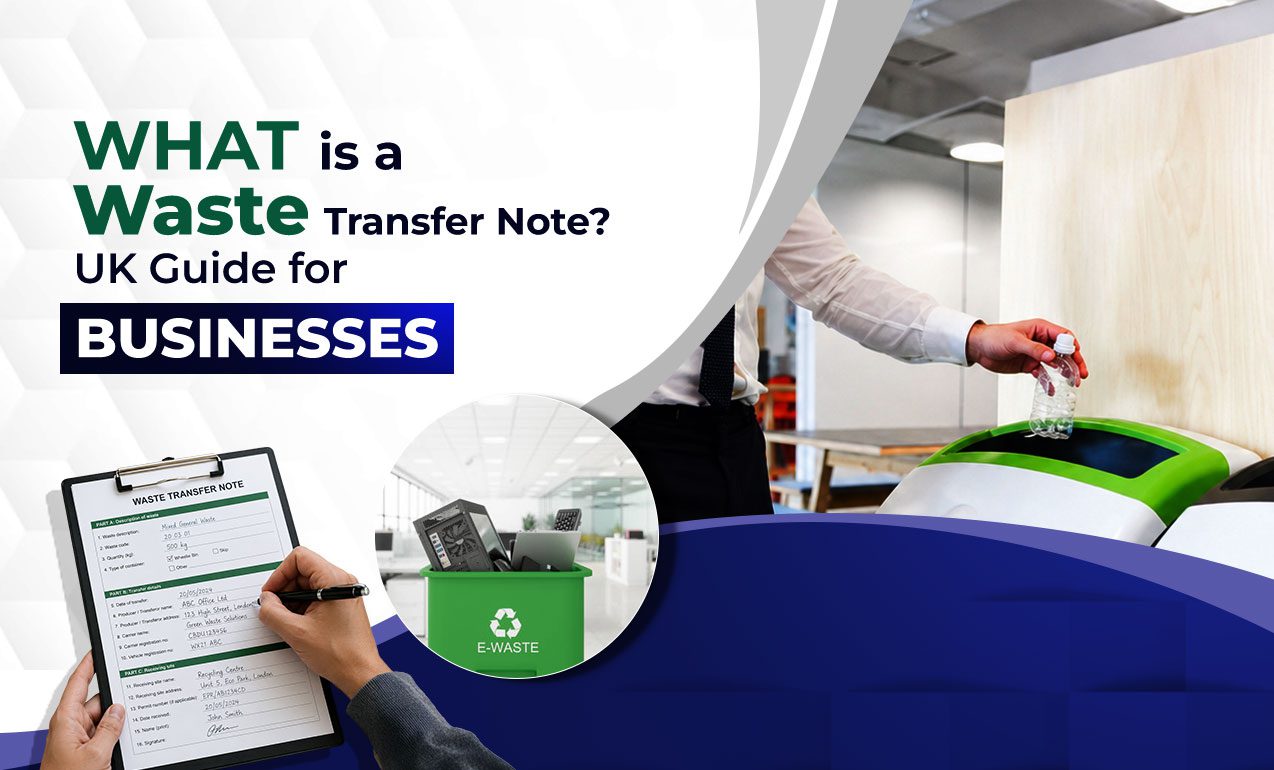
A Waste Transfer Note (WTN) is a legal document that records the transfer of non-hazardous waste from one party to another. In simple words, when a business hands its waste over to a contractor, carrier, or disposal facility, both parties must complete and sign a WTN. It is documentation done to confirm that the transfer took place and that the waste was handled in compliance with UK law.
The note records key details about the waste transfer, including:
• What the waste is – To accurately identify the waste type and ensure it is handled, transported, and disposed of correctly.
• Where it came from – To create a clear audit trail showing which business or premises produced the waste.
• Who transferred it – To record the organisation responsible for the waste before it was passed on.
• Who collected it – To confirm the waste was collected by an authorised and registered waste carrier.
• How the waste will be handled – To show whether the waste will be recycled, recovered, treated, or disposed of lawfully.
The document forms part of the UK’s duty of care waste disposal regulations under the Environmental Protection Act 1990.
A WTN creates a traceable record showing that waste has been handled responsibly and transferred to an authorised party.
For businesses, it acts as evidence that reasonable steps were taken to ensure lawful disposal. Hence, it’s a key requirement to fulfil in their waste disposal process.
Who Needs a Waste Transfer Note?
Any UK business or organisation that transfers controlled waste to another party needs a Waste Transfer Note. This includes:
• Businesses handing waste to an authorised waste contractor during an office clearance or refurbishment.
• Commercial property managers arranging waste removal between tenancies.
• Facilities managers overseeing fit-out or strip-out projects.
• Waste carriers and contractors receiving waste from a business client.
Both parties involved in the waste transfer sign the document: the waste producer (your organisation) and the waste carrier or recipient. Both must retain a copy for a minimum of two years.
The WTN requirement applies to most categories of commercial waste, including:
• Office furniture and fittings
• Paper, cardboard, and general office consumables
• Electrical and electronic equipment (WEEE)
• Construction and demolition waste from refurbishments
• White goods and kitchen appliances
Hazardous waste follows a separate documentation process, which is covered below.
Who is Responsible for Completing the Waste Transfer Note?
Responsibility for meeting the Waste Transfer Note legal requirements is shared between:
• The waste producer
• The waste carrier
• The receiving waste site
However, the business producing the waste cannot simply hand over responsibility and assume compliance has been met.
Organisations must verify that:
• The waste carrier is registered
• The receiving site is authorised
• Waste descriptions are accurate
• Documentation is complete
This is particularly important during office clearances and large commercial projects where multiple waste streams may be involved.
What Happens If You Don’t Have WTN?
Operating without a valid WTN is a violation under the Duty of Care regulations under the Environmental Protection Act 1990. The Environment Agency can issue fixed penalty notices and, in serious cases, pursue legal action through a higher court, where fines can be unlimited.
There are also some potential business consequences. If waste from your premises is fly-tipped or handled illegally, you must be able to prove that you transferred it to an authorised waste carrier. Without a valid Waste Transfer Note, you may struggle to demonstrate that your organisation disposed of the waste responsibly.
Missing or incomplete WTNs can create issues during compliance audits, landlord disputes, ESG reporting, or contractor reviews. Proper documentation shows that your business follows legal waste handling procedures and maintains a clear audit trail for every waste transfer.
What Must a Waste Transfer Note Include?
The Environment Agency specifies what a valid Waste Transfer Note must contain. While there is no single mandated template, all WTNs must include the following vital information to prove their legal compliance:
About the Waste
• A clear description of the waste in enough detail to identify its type, source, and composition.
• The quantity of waste being transferred, expressed in weight, volume, or number of containers.
• Whether the waste is loose or in a container, and if so, the type of container (e.g. sacks, bins, skips).
• The EWC code (European Waste Catalogue code) corresponding to the specific waste type. Each waste category has its own six-digit EWC code. For example, mixed municipal waste carries the code 20 03 01, while office paper and cardboard fall under 20 01 01.
• The type of container or vehicle used to transport the waste.
About the Transfer
• The date of the transfer.
• The address of the site where the waste was collected.
• The address of the site where the waste will be taken.
About the Parties
• The full name and address of the person or business passing on the waste (the transferor).
• The full name and address of the person or business receiving the waste (the transferee).
• Details of what each party is, in relation to the waste (for example: producer, carrier, broker, dealer, permit holder, or local authority).
• The waste carrier registration number for the person collecting the waste, where applicable.
• The environmental permit number or registered exemption reference for the site that will receive or treat the waste, where applicable.
Confirmation and Record-keeping
• Signatures from both parties confirming that the information is correct and that the waste hierarchy has been applied.
• The Standard Industrial Classification (SIC) code of the business producing the waste.
• WTNs (or season tickets) must be kept by both parties for at least two years and produced to regulators on request.
WTN vs. Hazardous Waste Consignment Note
Waste Transfer Notes cover non-hazardous controlled waste. When waste is classified as hazardous under the Hazardous Waste Regulations 2005, a different document is required: the Hazardous Waste Consignment Note.
The distinction matters because hazardous waste poses greater risks to human health and the environment, and the documentation requirements reflect that. Here is how the two documents differ:
| Waste Transfer Note | Hazardous Waste Consignment Note | Applies to | Non-hazardous controlled waste | Hazardous waste (as defined by the Hazardous Waste Regulations 2005) | Legal basis | Environmental Protection Act 1990 | Hazardous Waste Regulations 2005 | Retention period | Minimum 2 years | Minimum 3 years | Parties involved | Waste producer + waste carrier | Waste producer + carrier + receiving facility (consignee) | Pre-notification requirement |
| (The waste may require official approval from the Environment Agency before it can be transported) | No | Yes, in some circumstances (a consignment note must accompany the waste) | Common examples | Office furniture, cardboard, general WEEE | Batteries, fluorescent tubes, chemical waste, refrigerants |
In practice, most office clearances generate both types of waste. A clearance that removes furniture, paper, and IT equipment alongside batteries, fluorescent tubes, and paint cans will require both a WTN for the non-hazardous streams and a Hazardous Waste Consignment Note for the hazardous ones.
A professional clearance company issues both as a matter of course. If yours does not, ask why.
What is a Season Ticket Waste Transfer Note?
A standard Waste Transfer Note covers a single transfer of waste on a specific date. For businesses that transfer similar waste to the same contractor on a regular basis, completing a fresh WTN every time is administratively burdensome.
A Season Ticket Waste Transfer Note resolves this. It is a single document that covers multiple transfers of the same type of waste to the same recipient over a defined period, which can be up to 12 months.
To be valid, a season ticket WTN must:
• Cover only transfers of the same type of waste, using the same EWC codes, to the same recipient.
• Specify the period it covers (up to 12 months maximum).
• Be signed by both parties at the outset of the arrangement.
• Include all the same required information as a standard WTN, including waste descriptions, EWC codes, and carrier licence details.
Season ticket WTNs are most commonly used by businesses with ongoing clearance or waste removal contracts, such as facilities teams managing recurring office strip-outs, or property managers overseeing multiple tenancies. They reduce paperwork without reducing compliance.
Are Waste Transfer Notes Going Digital?
Yes, the UK waste sector is moving towards a nationwide digital waste tracking system.
The government’s plans aim to modernise how waste movement information is recorded and shared across the industry. The UK Government is rolling out a mandatory digital waste tracking system under the Environment Act 2021.
The new system, developed by the Environment Agency, requires waste producers, carriers, and receiving facilities to record and track waste transfers digitally through a centralised platform. Physical paper WTNs will eventually be replaced by digital records that are visible to regulators in real time.
The rollout is being phased. Consultation stages began in 2023, with the digital waste tracking system for businesses in England targeted for broader implementation from 2025 onward. Scotland, Wales, and Northern Ireland are operating on related but separate timelines through their respective environmental regulators.
What does this mean practically for facilities and operations managers?
• Digital waste tracking in the UK in 2026 will require businesses and their waste contractors to use compliant software platforms, rather than paper or PDF documents, to record transfers.
• Contractors who are not registered on the digital system will not be able to accept waste legally once the mandate takes full effect.
• Real-time visibility for regulators means non-compliant disposal will be far harder to conceal and far easier to attribute.
The transition reinforces a point that is worth making clearly: the direction of travel for waste documentation in the UK is toward greater transparency, not less. Choosing a clearance partner that already operates with digital documentation, issues WTNs as a matter of standard practice, and maintains an auditable record of every disposal is not just about current compliance. It is about being ready for the compliance landscape ahead.
Your WTN Checklist: What to Ask Your Office Clearance Company
Not all office clearance providers operate to the same compliance standards. While many companies will collect and remove waste, the real difference lies in how properly the waste is documented, processed, and tracked after it leaves your premises.
That is why it is important to ask the right questions before appointing a clearance contractor. A professional office clearance company should be transparent about its waste management processes, licensing, documentation procedures, and environmental compliance standards.
Before you confirm any office clearance booking, these are the questions worth putting to your contractor:
• Do you issue Waste Transfer Notes for all non-hazardous waste streams?
• Are EWC codes included for each waste category on the WTN?
• Do you provide Hazardous Waste Consignment Notes where applicable?
• Is your waste carrier licence valid and current?
• Are the receiving facilities you use, licensed by the Environment Agency?
• Do you provide WEEE Certificates and Data Destruction Certificates in addition to the WTN?
• Are you registered for, or preparing for, the digital waste tracking system?
A reputable clearance company should answer yes to all of the above without hesitation if there is uncertainty around any of these points that is worth taking seriously before you sign off on a clearance.
Waste Transfer Notes Matters for Your UK Business
Understanding what a waste transfer note is essential for any UK business that produces commercial waste.
WTNs are a core part of legal waste compliance and provide evidence that waste has been transferred responsibly through authorised channels.
For facilities managers, office managers, landlords, and procurement teams, maintaining accurate waste records helps reduce operational risk. It also supports environmental compliance and demonstrates responsible business practices.
Waste regulations continue to evolve, particularly with the rollout of digital waste tracking systems. Businesses that prioritise proper documentation and compliance processes will be better positioned to manage future regulatory requirements effectively.
Rely on a clearance company that handles compliance seamlessly!
At Office Clearance, we ensure your waste is handled responsibly, collected by specialised carriers, and supported with the correct transfer documentation for complete peace of mind.
Every clearance we carry out comes with a full compliance pack as standard: Waste Transfer Notes, WEEE Certificates where applicable, and Data Destruction Certificates for any data-bearing devices. We issue all documentation after every clearance without being asked.
If your organisation requires professional support with commercial waste disposal or office clearances, contact our team today.

